



















Search History
Clear History
{{item.search_key}}
Hot Searches
Change
{{item.name}}
{{item.english_name}}
Subscribe eNews
Once A Week Once Every Two Weeks
{{sum}}
Login Register

Applications

Sustainable TPE for comfort and durable smartwatch straps

WACKER’s ceramifying silicone supporting thermal barrier at the Battery Show

Clariant catalysts continue to shrink carbon footprints

Products

Super carbon fiber lattices: Foam-like weight + aluminum-level performance

EyeC automated print inspection for complex packaging processes

The “Material Effect” behind World Cup 2026

Activities

  • Fakuma 2026: Multi-faceted program for plastics industry

  • Plast 2026 expects 200 new exhibitors and strong international presence

  • 350,000+ visitors! CHINAPLAS 2026 shatters every record in the book

Pictorial

News Videos

Inside Moretto: A tour of their Italian production facilities

Top 10 Technology Trends awards presented at CHINAPLAS 2026

MAAG x SIKORA: Smart pelletizing + precise inspection - More stable, carbon-reduced

Conference Videos

Summit Dialogue: Policy alignment and practices in plastic recycling across Asia

Interview: Pathways for development of plastics recycling in Malaysia

Driving systemic change: Unilever’s evolution in the circular economy

Corporate/Product Videos

For Rubber & Plastic Extrusion Equipment, trust Hebei Zhongsen! Custom Extruders, Traction Machines & Vulcanizing Lines

Is Your Mold Supplier Really Giving You Peace of Mind?

Kurtz GmbH & Co.

Home > News > Chemicals

Super carbon fiber lattices: Foam-like weight + aluminum-level performance

Source:Adsale Plastics Network Date :2026-06-11 Editor :RC
Copyright: This article was originally written/edited by Adsale Plastics Network (AdsaleCPRJ.com), republishing and excerpting are not allowed without permission. For any copyright infringement, we will pursue legal liability in accordance with the law.

Researchers at Department of Mechanical Engineering in the Seoul National University (SNU) have developed a new class of ultralight structural materials that combine the load-bearing strength of engineering materials with the weight of foam.
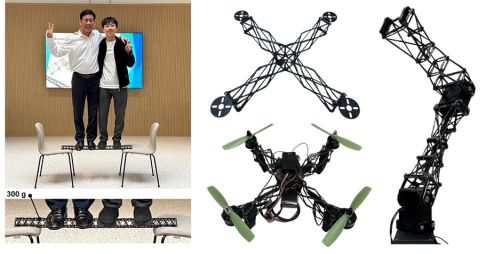
 

Seoul University_ultra-light CF lattices.jpg

Prof. Sung-Hoon Ahn (left) and Dr. Jun Young Choi of SNU Department of Mechanical Engineering standing on a composite beam that supports a total load of approximately 150 kg. The prototype structures of drone and robotic arm are developed by the research team. (Source: Seoul National University)


Using a method called 3D node winding, the team created mesoscale carbon fiber lattices that achieve aluminum-level performance on a strength-to-weight basis while weighing as little as 1/100 the weight of aluminum.


Challenges in layer-by-layer structure


Today’s carbon fiber composites already offer high strength at low weight, but they are typically manufactured by stacking thin layers or assembling multiple components. These processes limit design freedom and introduce weak interfaces where layers or parts meet.


Even newer approaches, such as 3D-printed composites, rely on layer-by-layer fabrication. This creates internal boundaries that disrupt load transfer, forcing a trade-off between structural complexity and mechanical reliability.


Building structure from single continuous fiber


To overcome these limitations, the research team turned to a fundamentally different fabrication strategy. Instead of assembling or stacking materials, the structure is defined by placing a single continuous carbon fiber directly in three-dimensional space, a unifying concept that “binds them all together in perfect unity”.


The process begins with a temporary scaffold that defines nodal geometry. A long carbon fiber is then wound across these nodes, forming a spatial lattice network. Once the geometry is established, the structure is consolidated through resin impregnation, producing a solid composite.


Because the fiber remains continuous throughout the structure, forces are transmitted without interruption, avoiding the stress concentrations and failure points commonly associated with joints and interfaces.


High strength at ultralow weight


The resulting structures exhibit compressive strengths of approximately 10 to 30 megapascals, comparable to construction-grade materials such as concrete in compression.


While this remains below the absolute strength of high-grade metals, the structures achieve exceptional performance when normalized by weight, reaching aluminum-level efficiency at dramatically reduced mass.


At equal weight, the lattices can be up to ten times stronger than conventional lattice structures. This improvement arises from continuous load paths, which enable more efficient force distribution and reduce inactive material within the structure.
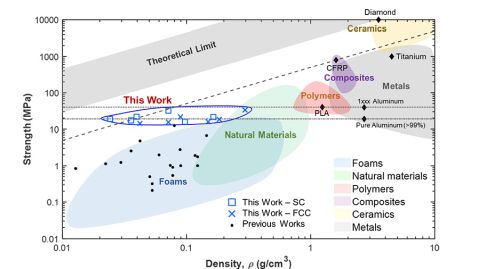
 

Seoul University_ultra-light CF lattices_graph.jpg

Strength–density performance comparison of the developed 3D carbon fiber composite lattice structure. (Source: Seoul National University)


Demonstrated in drone frame


To validate the approach in a real-world system, the researchers applied the structure to a drone frame with:

  • reduced structural weight by approximately 79% compared to conventional designs, and

  • a 33% increase in flight time under the same operating conditions.


These results confirm that structural weight reduction translates directly into improved system-level performance, particularly in applications where mass is a primary constraint.


Developing towards scalable, design-driven structures


Beyond material performance, the work reframes how load-bearing systems can be designed and manufactured.


Previously, such continuous three-dimensional fiber architectures were difficult to scale using conventional manufacturing methods. However, this approach aligns naturally with robotic, AI-driven fabrication systems, where complex fiber trajectories can be generated and executed directly from digital designs.


As these systems advance, they are expected to enable scalable production of architected composites that would be impractical to fabricate by hand.


The implications extend across multiple industries where weight and efficiency are critical, such as aerospace and mobility systems, robotics, and construction. More broadly, the method supports a transition from component-based engineering to integrated structural systems defined by geometry, continuity, and automated fabrication.

 Like 丨  {{details_info.likes_count}}
3D Print material
Carbon fiber
 NANTONG FUYUAN CARBON FIBER RECYCLING CO., LTD      
 SHANGHAI HUAZHENG COMPOSITES CO.;LTD      
 SHANGHAI JANTON PLASTIC AND CHEMICAL CO.,LTD      

The content you're trying to view is for members only. If you are currently a member, Please login to access this content.   Login

Source:Adsale Plastics Network Date :2026-06-11 Editor :RC
Copyright: This article was originally written/edited by Adsale Plastics Network (AdsaleCPRJ.com), republishing and excerpting are not allowed without permission. For any copyright infringement, we will pursue legal liability in accordance with the law.

Researchers at Department of Mechanical Engineering in the Seoul National University (SNU) have developed a new class of ultralight structural materials that combine the load-bearing strength of engineering materials with the weight of foam.


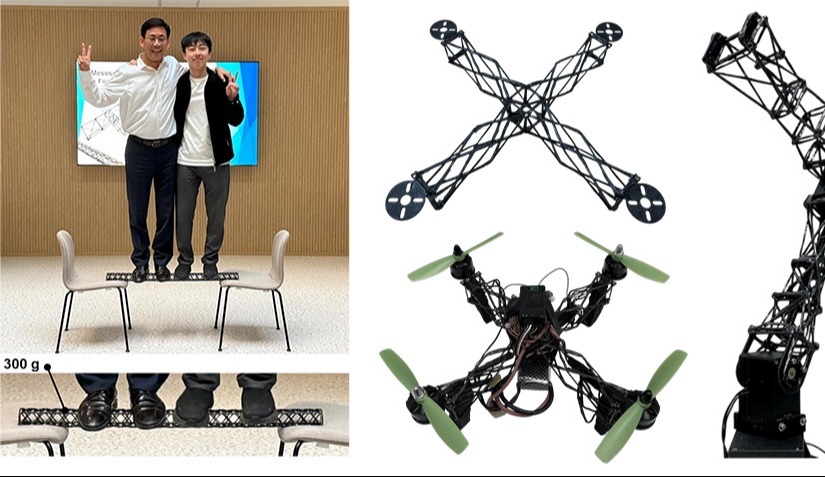
Seoul University_ultra-light CF lattices.jpg

Prof. Sung-Hoon Ahn (left) and Dr. Jun Young Choi of SNU Department of Mechanical Engineering standing on a composite beam that supports a total load of approximately 150 kg. The prototype structures of drone and robotic arm are developed by the research team. (Source: Seoul National University)


Using a method called 3D node winding, the team created mesoscale carbon fiber lattices that achieve aluminum-level performance on a strength-to-weight basis while weighing as little as 1/100 the weight of aluminum.


Challenges in layer-by-layer structure


Today’s carbon fiber composites already offer high strength at low weight, but they are typically manufactured by stacking thin layers or assembling multiple components. These processes limit design freedom and introduce weak interfaces where layers or parts meet.


Even newer approaches, such as 3D-printed composites, rely on layer-by-layer fabrication. This creates internal boundaries that disrupt load transfer, forcing a trade-off between structural complexity and mechanical reliability.


Building structure from single continuous fiber


To overcome these limitations, the research team turned to a fundamentally different fabrication strategy. Instead of assembling or stacking materials, the structure is defined by placing a single continuous carbon fiber directly in three-dimensional space, a unifying concept that “binds them all together in perfect unity”.


The process begins with a temporary scaffold that defines nodal geometry. A long carbon fiber is then wound across these nodes, forming a spatial lattice network. Once the geometry is established, the structure is consolidated through resin impregnation, producing a solid composite.


Because the fiber remains continuous throughout the structure, forces are transmitted without interruption, avoiding the stress concentrations and failure points commonly associated with joints and interfaces.


High strength at ultralow weight


The resulting structures exhibit compressive strengths of approximately 10 to 30 megapascals, comparable to construction-grade materials such as concrete in compression.


While this remains below the absolute strength of high-grade metals, the structures achieve exceptional performance when normalized by weight, reaching aluminum-level efficiency at dramatically reduced mass.


At equal weight, the lattices can be up to ten times stronger than conventional lattice structures. This improvement arises from continuous load paths, which enable more efficient force distribution and reduce inactive material within the structure.


Seoul University_ultra-light CF lattices_graph.jpg

Strength–density performance comparison of the developed 3D carbon fiber composite lattice structure. (Source: Seoul National University)


Demonstrated in drone frame


To validate the approach in a real-world system, the researchers applied the structure to a drone frame with:

  • reduced structural weight by approximately 79% compared to conventional designs, and

  • a 33% increase in flight time under the same operating conditions.


These results confirm that structural weight reduction translates directly into improved system-level performance, particularly in applications where mass is a primary constraint.


Developing towards scalable, design-driven structures


Beyond material performance, the work reframes how load-bearing systems can be designed and manufactured.


Previously, such continuous three-dimensional fiber architectures were difficult to scale using conventional manufacturing methods. However, this approach aligns naturally with robotic, AI-driven fabrication systems, where complex fiber trajectories can be generated and executed directly from digital designs.


As these systems advance, they are expected to enable scalable production of architected composites that would be impractical to fabricate by hand.


The implications extend across multiple industries where weight and efficiency are critical, such as aerospace and mobility systems, robotics, and construction. More broadly, the method supports a transition from component-based engineering to integrated structural systems defined by geometry, continuity, and automated fabrication.

全文内容需要订阅后才能阅读哦~
立即订阅

Recommended Articles

Chemicals
Super carbon fiber lattices: Foam-like weight + aluminum-level performance
 2026-06-11
Chemicals
The “Material Effect” behind World Cup 2026
 2026-06-10
Chemicals
Plast 2026: RadiciGroup solutions for automotive, E&E and water management
 2026-06-05
Chemicals
Envalior’s new Tepex composite reduces 50% carbon footprint
 2026-06-04
Chemicals
Delta Tecnic designs new masterbatch formulations to reduce carbon footprint
 2026-06-04
Chemicals
Clariant FAMAX catalysts support two Yihua formaldehyde plants in China
 2026-06-01

You May Be Interested In

Change

  • People
  • Company
loading... No Content
{{[item.truename,item.truename_english][lang]}} {{[item.company_name,item.company_name_english][lang]}} {{[item.job_name,item.name_english][lang]}}
{{[item.company_name,item.company_name_english][lang]}} Company Name    {{[item.display_name,item.display_name_english][lang]}}  

Polyurethane Investment Medical Carbon neutral Reduce cost and increase efficiency CHINAPLAS Financial reports rPET INEOS Styrolution Evonik Borouge Polystyrene (PS) mono-material Sustainability Circular economy BASF SABIC Multi-component injection molding machine All-electric injection molding machine Thermoforming machine

Super carbon fiber lattices: Foam-like weight + aluminum-level performance

识别右侧二维码,进入阅读全文
下载
x 关闭
订阅
亲爱的用户,请填写一下信息
I have read and agree to the 《Terms of Use》 and 《Privacy Policy》
立即订阅
Top
Feedback
Chat
News
Market News
Applications
Products
Video
In Pictures
Specials
Activities
eBook
Front Line
Plastics Applications
Chemicals and Raw Material
Processing Technologies
Products
Injection
Extrusion
Auxiliary
Blow Molding
Mold
Hot Runner
Screw
Applications
Packaging
Automotive
Medical
Recycling
E&E
LED
Construction
Others
Events
Conference
Webinar
CHINAPLAS
CPS+ eMarketplace
Official Publications
CPS eNews
Media Kit
Social Media
Facebook
Linkedin