














CEFLEX: Broader markets crucial for PCR derived from flexible packaging

Recent disruptions in global polymer markets, combined with a sharp rise in virgin plastic prices, have strengthened the price competitiveness of recycled material and driven increased demand.
However, while these dynamics may deliver short-term economic benefits, the volatility of recent years has shown that demand can shift rapidly. This underscores the need for sustained focus on the underlying structural barriers to demand — ensuring that sufficient markets for recycled plastic are maintained across all market conditions.
CEFLEX, an initiative representing entire value chain of flexible packaging in Europe, released a report “Secondary Applications for Recycled Content – Key Insights for Flexible Packaging”, examining how recycled material derived from polyolefin-based flexible packaging is likely to be used in practice as EU legislative targets for recycled content and recycling rates come into force.
Additional PCR-based flexible packaging required to achieve PPWR targets
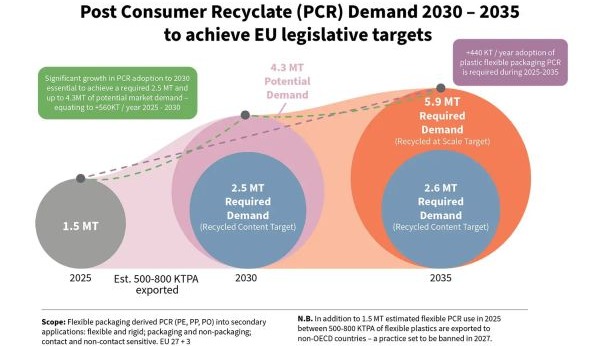
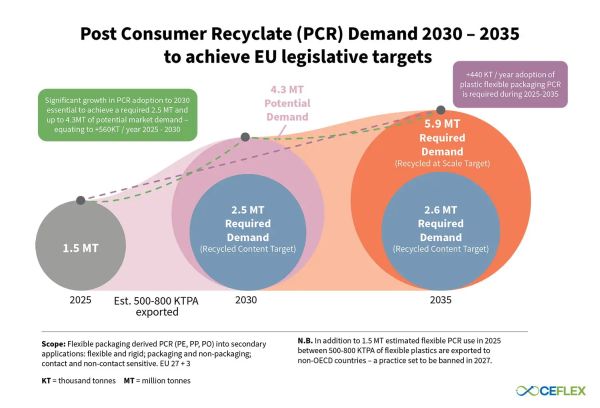
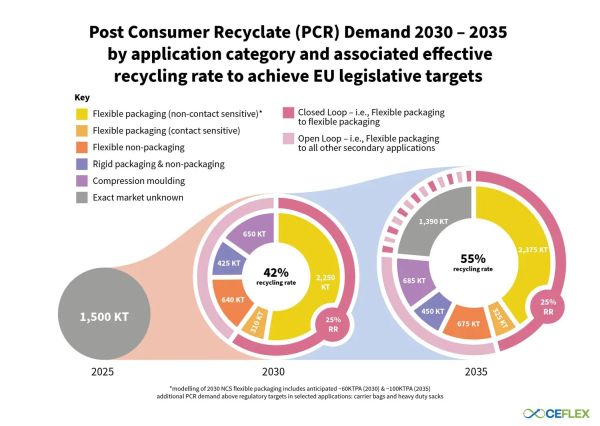
The report finds that around 2.5 million tons of flexible packaging derived post-consumer recycled (PCR) material will be required by 2030 to meet PPWR recycled content targets in flexible packaging, encompassing recycled polyethylene, polypropylene and mixed polyolefins.
The report also identifies that the 55% recycling rate targets for all plastic packaging formats in 2035 will have an additional significant effect on PCR markets and use.
This target drives more material through the system, effectively meaning that markets and secondary applications will need to be found for an estimated 5.9 million tons of flexible packaging derived PCR in 2035.
Taken together, this means adoption of an additional 440,000 tons a year of flexible packaging derived PCR is required every year between 2025-2035 to achieve PPWR targets.
CEFLEX highlights that material quality, and the collection, sorting and recycling infrastructure needed to ensure recycled materials can be used again will be critical in enabling this shift.
Pushing recycling rates: Non-regulated markets and open-loop applications
As PPWR will be fully implemented in August 2026, the recycled content targets from the regulation will create strong demand for recycled content in packaging. However, the wider circular economy for flexible packaging and recycling rate targets also depend on markets that are not directly driven by PPWR.
CEFLEX analysis identifies a broader set of established secondary markets that already use, and could absorb more PCR-based flexible packaging. When these markets are included, total potential PCR demand rises to around 4.3 million tons in 2030.
These markets include construction films, refuse sacks, transport packaging, horticulture products and other rigid applications. They are important because packaging alone is unlikely to absorb all the recycled material needed to support higher recycling rates.
Open-loop applications provide further outlets for material that can replace virgin resources, but they are often more exposed to normal market conditions. If PCR is not available at the right quality, price and consistency of supply, users will revert to virgin material.
Meeting the minimum PCR demand in packaging is a priority, but it is not enough on its own. A functioning circular materials system also needs wider secondary applications to develop in parallel, so that higher recycling rates translate into more recycled material replacing virgin resources.