











Interview with Yizumi: Is in-mold coating the next big trend for auto parts manufacturing?

Polyurethane (PUR) in-mold coating (IMC) has become one of the trending technologies in automotive manufacturing in recent years. It combines injection molding and surface coating into a single step. This process can eliminate traditional coating steps, speed up production, and create new possibilities for manufacturing automotive interiors, exteriors, and smart-cockpit components.
Yizumi was one of the first Chinese companies to develop IMC technology. In 2024, the company began mass-producing IMC equipment. Adsale Plastics Network spoke with Glory Chen, Senior Manager, New Process Application Engineering, Injection Molding Machine Division, Yizumi Precision Molding Technology Co., Ltd. In this interview, Chen explained why IMC is trending, what challenges remain before full-scale production, and which applications will adopt it first.
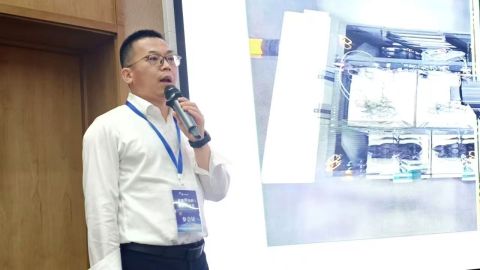
Glory Chen, Senior Manager, New Process Application Engineering, Injection Molding Machine Division, Yizumi Precision Molding Technology Co., Ltd.
Why invest in IMC technology?
APN: Why did Yizumi decide to develop IMC technology?
Chen: After I joined Yizumi in 2016, I began looking for new processing directions with development potential. At that time, I became interested in reactive injection molding (RIM) technology, and gradually shifted our R&D focus to RIM with PUR.
From a manufacturing perspective, traditional plastic products require multiple steps, including polymerization, pelletizing, and injection molding, so the production chain is relatively long. In contrast, RIM uses low-molecular liquid polymers directly inside the mold to complete the polymerization reaction and produce the final product. In essence, it explores a more simplified and efficient manufacturing approach.
The growth of new-energy vehicles (NEVs) showed us a real market opportunity. Through discussions with these automakers, we found that IMC solves two long-standing problems of conventional coating.
First is environmental impact. Traditional coating creates VOC emissions, consumes high energy, and requires complex waste treatment. These are major concerns for automakers. Second is manufacturing efficiency. Standard plastic parts need many steps after injection molding, including transport, cleaning, priming, sanding, topcoating, and curing. This entire process can take several days or even over a week.
IMC completes the surface coating directly inside the mold during the molding process. This combines part manufacturing and surface decoration into one single step, which significantly reduces downstream processing.
At the same time, Tesla is leading NEV manufacturers to adopt manufacturing approaches like integrated die casting. This aims to reduce the number of components and minimize manufacturing complexity. IMC aligns perfectly with this philosophy.
Traditional automakers already have mature coating supply chains, so they have less incentive to change. In contrast, NEV manufacturers are more willing to try new manufacturing approaches, which creates fresh market opportunities for IMC technology.
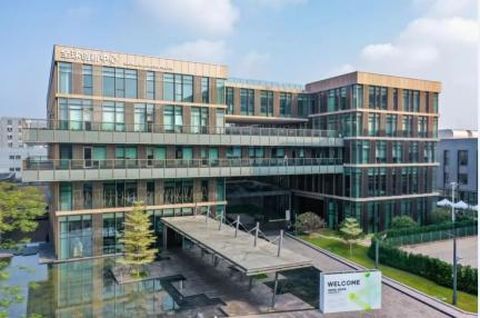
Yizumi Global Innovation Center.
APN: How has the growth of the NEV industry created new opportunities for IMC technology?
Chen: China’s NEV industry provides an excellent environment for development of new manufacturing processes. Automakers, component suppliers, material companies, and equipment manufacturers now collaborate with high efficiency. This ecosystem is crucial for developing new processing like IMC.
Demand in the Chinese market is essentially demand in the global market. Currently, domestic customers are shifting their focus. They no longer just want to verify that IMC technology is feasible; they want to know if it can achieve reliable mass production.
Equipment manufacturers have to do more than just supply machinery. They must participate in every stage, including product development, mold commissioning, process optimization, and the mass production ramp-up.
Compared to overseas competitors, Chinese companies offer advantages beyond just lower costs. More importantly, they can leverage the local supply chain to provide fast, responsive technical support. This speed is critical given the rapid development cycles of NEVs.
What stage of development is IMC technology currently at?
APN: What stage is IMC technology at today?
Chen: Overall, IMC technology is still in the commercialization and introduction stage. Many companies have already completed material and processing validation, and even on-vehicle testing. However, the number of projects that have truly achieved stable mass production remains limited.
For example, Li Auto’s earlier ultra-large exterior part project has completed material and processing validation and has undergone on-vehicle testing. Still, it has not entered large-scale mass production.
The early mass-production projects in the industry were projects of Geely, with Minth Group supporting as the supplier. Minth began developing IMC equipment and processing early on. After years of experience accumulation, the group successfully delivered practical projects.
Yizumi officially started its R&D of in-mold coating in 2017 and first showcased a complete solution at CHINAPLAS 2019. At that time, the equipment, materials, and processing systems relied heavily on imports. It was not until 2024 that Yizumi delivered production-ready equipment for Volkswagen’s reading light panel project, achieving its first mass-production milestone.
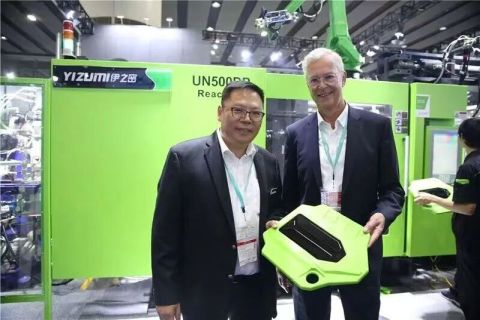
Yizumi presented ReactPro PUR in-mold coating solution at CHINAPLAS 2019. Richard Yan, the Chairman and CEO, and Dr. Hans Wobbe, Chief Strategy Officer.
Why is IMC so difficult to industrialize?
APN: Why is the industry attention increasing, yet large-scale adoption still has not emerged?
Chen: Many people expect the biggest challenge in IMC comes from the equipment. In my view, the real difficulty lies in integrating processes across completely different fields.
Conventional injection molding mainly processes thermoplastic materials. In contrast, IMC uses thermosetting, reactive liquid materials like PUR.
These two material systems differ significantly in molding methods, process windows, and performance requirements. Therefore, achieving stable mass production requires solving multiple issues, including material matching, product structural design, mold development, equipment integration, and process commissioning.
It is worth noting that implementing IMC involves a complete manufacturing system, not just a single piece of equipment.
Additionally, the injection molding industry currently faces a talent shortage. There are very few professionals who understand injection molding machinery, are familiar with PUR materials, and understand the automotive component development workflow.
Many companies need to build experience continuously while pushing projects forward in real production conditions. This is also an important reason why the technology is still in the introduction stage.
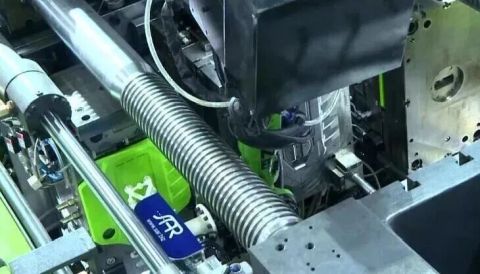
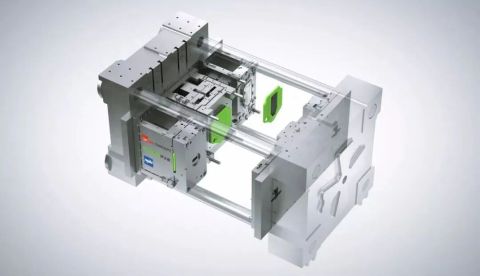
One-step molding of automotive engine covers with localized high-gloss polyurethane surfaces.
APN: Since IMC involves equipment, materials, and molds, how do material factors affect industrialization?
Chen: In reality, IMC implementation is a typical system engineering effort where equipment, molds, and materials are all indispensable.
In real project development, material performance directly affects coating thickness, appearance quality, cycle time, and ultimately the yield rate.
For instance, if a customer wants a thinner coating, better surface quality, or more stable mass production, equipment optimization alone cannot solve the problem. Material systems and process parameters must also be adjusted in parallel.
Wanhua Chemical has strong R&D, supply, and cost-control capabilities in PUR raw materials, which is a major reason we chose to cooperate with them. By setting up a joint testing platform, we can develop materials and validate molding processes in parallel based on customer requirements.
The advantage of this collaboration is not only about reducing material costs. More importantly, it helps the industries solve key issues such as substrate compatibility with PUR coatings, thin-layer molding, surface quality control, and yield improvement.
As IMC technology moves further into industrialization, competition will shift from individual equipment performance to collaborative capabilities across the entire supply chain.
Which automotive parts will adopt IMC first?
APN: Which automotive parts are currently more suitable for IMC?
Chen: At this stage, products with relatively flat structures are easier to industrialize. Examples include interior components, decorative parts around the center console, exterior flat panels, and some integrated vehicle electronics components. Among these, certain interior components, crystal-like decorative parts, and ambient light assemblies have already commercialized.
A major feature of IMC is that its molding temperature and pressure are relatively low. Typically, mold temperature is controlled between 60°C and 80°C, and cavity pressure is around 160 bar, which is far lower than conventional injection molding processes.
These low-temperature and low-pressure characteristics make the technology especially suitable for integrating electronic components. For example, vehicle displays can be directly encapsulated inside the product. The PUR surface creates a crystal-like visual effect and also offers a self-healing capability—minor scratches can gradually recover after exposure to sunlight.

Jetour Shanhai L7 Plus features in-mold coated crystal-like ambient lighting (Photo: Jetour)
APN: In the future, which parts are likely to achieve scaled adoption first?
Chen: Looking at future applications, I believe areas like smart cockpits, human-machine interfaces, and smart exterior components could become new growth areas. In terms of the upcoming industrialization timeline, medium-sized exterior fixed parts with relatively simple structures, such as trim panels and spoilers, are more likely to achieve early breakthroughs.
Over the long term, large integrated exterior parts, such as bumpers, roof modules, and sunroof assemblies, remain key focus areas for the industry. However, large parts require higher dimensional accuracy.
Currently, the industry's typical PUR coating thickness is about 0.5 mm. If underlying thermoplastic substrates like PP or PC warp, the coating thickness becomes uneven, ruining the final appearance.
Looking ahead, as equipment precision, material systems, and mold technology improve, there will be room to reduce coating thickness even further, helping reduce material consumption.