





















Making 3D-printable elastic polymer tough and durable

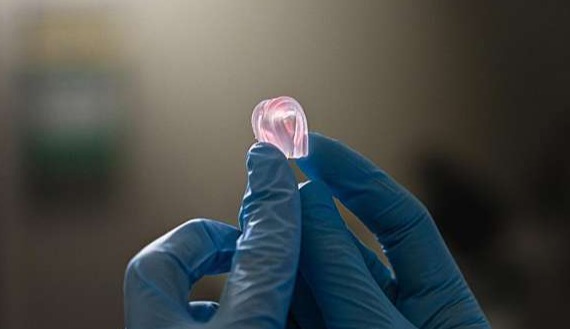
Researchers from École polytechnique fédérale de Lausanne (EPFL) in Switzerland have discovered a rubber-like, soft material originally optimized for 3D printing can be both tough and durable.
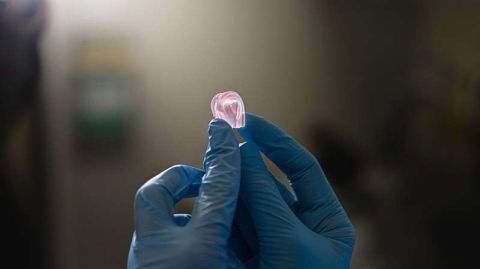
Double network granular elastomers (DNGEs).
In 2024, researchers from the Soft Materials Laboratory (SMaL) in EPFL's School of Engineering introduced double network granular elastomers (DNGEs): rubber-like materials made of microscopic elastomer particles connected by a softer elastomer network. DNGEs were designed as 3D printing inks for structures with finely tuned mechanical properties.
The team has recently published a follow-up study in Science Advances showing that the same architecture that enables DNGEs to be 3D printed with unprecedented mechanical control also delivers strong resistance to both fracture and fatigue.
DNGEs: Varied internal structure boost toughness and durability
DNGEs are able to overcome the typical trade-off between toughness and fatigue resistance thanks to their uniquely varied internal structure. The two different networks—one made of granular elastomer particles and one of soft elastomer—share mechanical strain between them, making the material stronger overall.
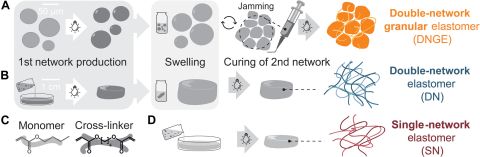
Difference between DNGE, DN, and SN systems. (Source: Science Advances)
In experiments, optimized DNGEs demonstrated fracture toughness values up to 15 times higher than comparable elastomers and fatigue resistance values up to three times higher.
When stretched, the materials redistribute mechanical stress from the stiff micro-particles into the softer regions between them. There, strain energy can be repeatedly dissipated through the sliding and rearrangement of polymer chains, rather than through the irreversible breakage of polymer bonds, limiting permanent damage.
The DNGEs' granular structure also changes how cracks move through them. Rather than following a straight path, cracks prefer to travel through the softer regions between the elastomer microparticles, producing a winding route that slows their growth and delays failure.
Applications and further research
Such materials could help extend the lifetime of soft robots, electronics and biomedical devices, where components are subjected to repeated stresses and deformations over long periods.
The team is already working on further optimizing its material for sustainability, for example by using biodegradable elastomers and those derived from recycled materials.