




















Material Selection & Sourcing Priorities for Beverage Bottles and PET Sheets

Process Compatibility to Meet Diversified Processing Needs
For downstream manufacturers, whether a PET raw material can adapt to various processing methods directly impacts production efficiency and end-product applications. The KS-262 bottle-grade polyester chips support both blow molding and sheet extrusion, catering to the manufacturing of diverse packaging products and offering flexible material options for enterprises.
Core Indicators to Support Material Selection for Procurement
Key specifications of KS-262:
(1)Intrinsic Viscosity: 0.790±0.015 dL/g
(2)Acetaldehyde Content: ≤1 μg/g
(3)Moisture Content: ≤0.4%
(4)Dust Content: ≤100 ppm

These metrics deliver clear references for material evaluation and process alignment to buyers focused on molding stability and application matching.
Core Production Technology: One-Step High-Viscosity Resin MTR Technology
MTR is a new technology for producing PET resin from the feedstocks PTA (purified terephthalic acid) and EG (ethylene glycol), including conventional co-monomers and additives, in a melt-phase polymerization process at 260-280°C under low vacuum. What is new here is that the technology produces a resin with a final high intrinsic viscosity of up to 0.86 in a one-step, ready to use process.
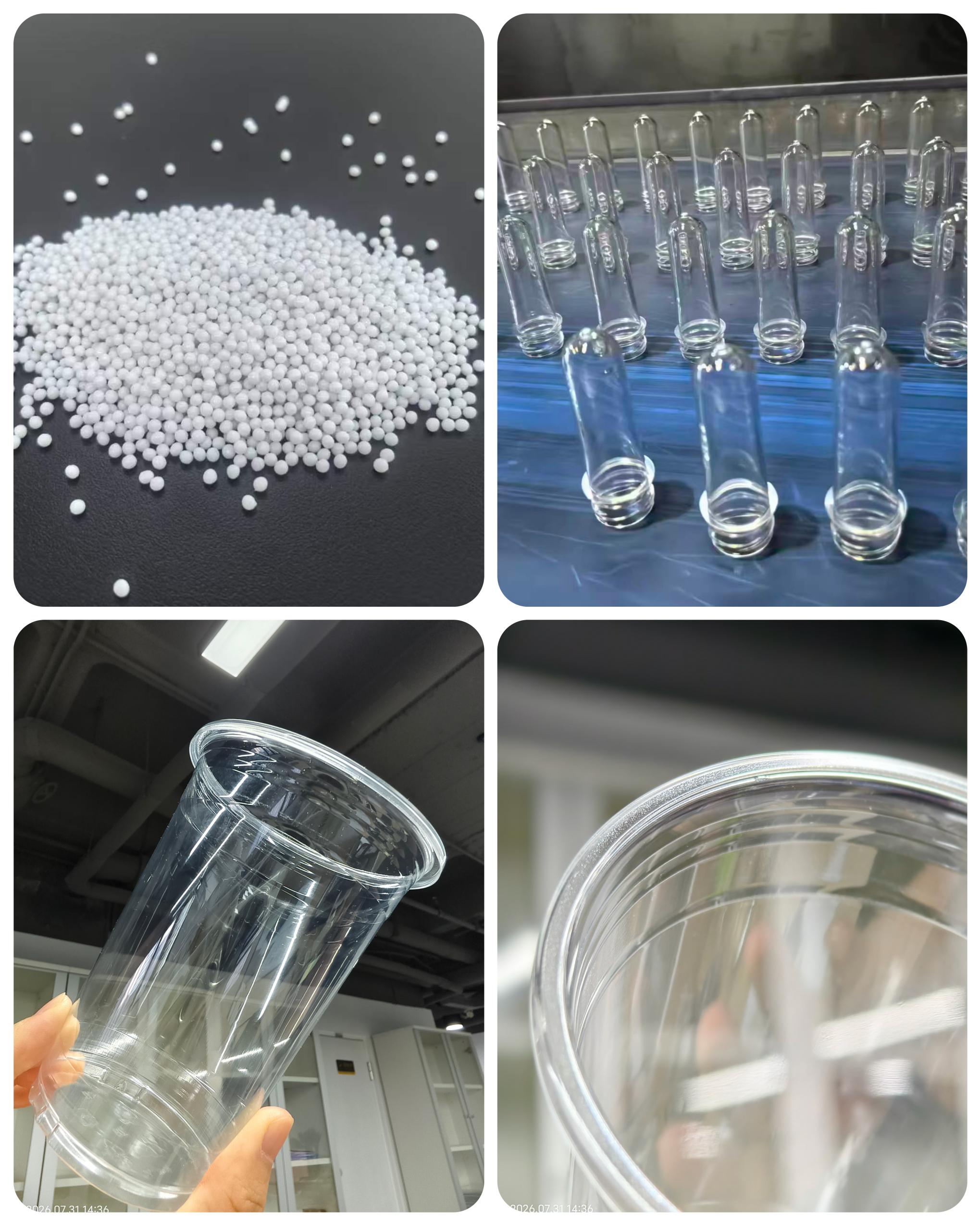
Our production line adopts MTR technology, which is somewhat different from standard SSP lines. JBF Belgium and Octal also operate MTR production lines. Resin manufactured via MTR lines features a slightly lower L value, meaning the material is marginally darker than resin from SSP lines. However, MTR resin suffers far less IV drop during downstream processing. Additionally, it delivers energy savings during drying and injection molding procedures.
If you want to learn more about the application compatibility of bottle-grade polyester chips in specific packaging scenarios,
Visit our company page to send your inquiry 👇
KOKSAN (NANTONG) NEW MATERIAL CO,LTD - CPRJAdsale Plastics Network