


















Mind the sustainability gap: What the new EcoVadis report means for global exporters

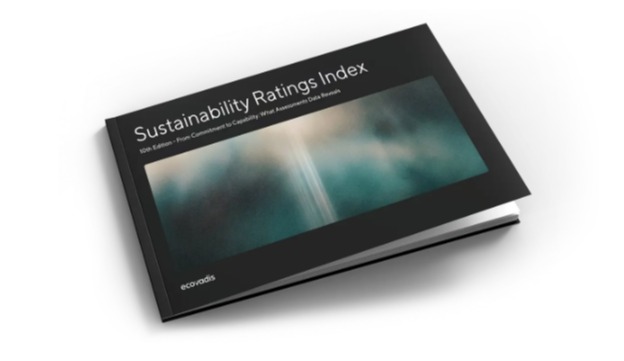
Global supply chain sustainability remains severely constrained by data blind spots, missing risk frameworks, and limited scope 3 reporting, according to the tenth edition of the Sustainability Ratings Index from global sustainability rating leader, EcoVadis.
Analyzing nearly 200,000 scorecards from more than 100,000 companies globally between 2021 and 2025, the report reveals a stark structural deficit: four out of five assessed companies still lack a documented process for identifying or managing supply chain sustainability risks.
This underscores a widening divide across international trade—while suppliers advance operational carbon improvements, buyer organizations remain unable to exercise verifiable procurement oversight.
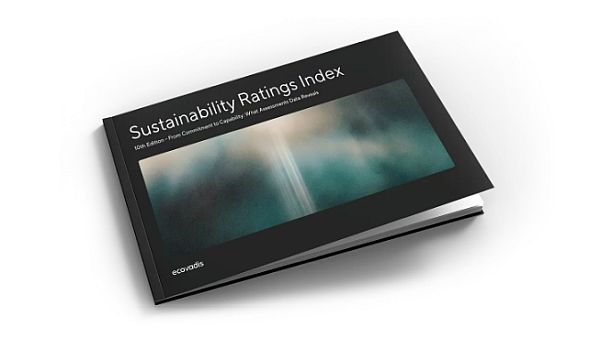
The tenth edition of the Sustainability Ratings Index. (Source: EcoVadis)
Supply chain bottlenecks: Scope 3 disclosures and AI constraints
Despite rising corporate investment in ESG initiatives, critical reporting gaps persist across global value chains:
‧ Scope 3 reporting deficit: 73% of rated companies fail to report upstream Scope 3 greenhouse gas emissions, 77% do not track downstream emissions, and 78% lack science-based emission reduction targets under the Science Based Targets initiative (SBTi).
‧ Restricted data flow: Fewer than 1% of suppliers share detailed sustainability metrics directly with buyers, crippling cross-supply-chain transparency.
‧ Limits of procurement AI: Although 68% of corporate buyers deploy AI in procurement programs, technology cannot fix underlying data scarcity: 30% of suppliers submit zero carbon emissions data, while 26% provide only aggregated Scope 1&2 figures.
“Better software does not close that gap,” said Sylvain Guyoton, Chief Rating Officer at EcoVadis. “The measurement problem lives in the supply base itself, and closing it requires sustained engagement over time: structured assessment, scored performance and documented follow-through.”
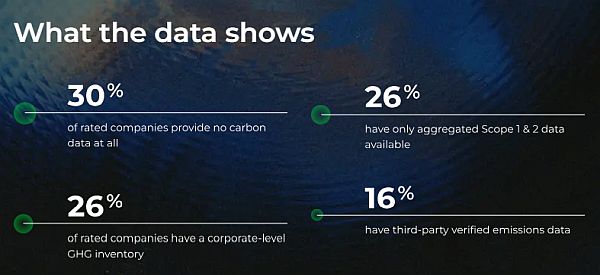
The report finds 30% of suppliers submit no carbon emissions data, and 26% share only aggregated Scope 1 and 2 figures. (Source: EcoVadis)
Renewable energy progress vs. lagging procurement frameworks
While operational action on renewable energy is advancing, strategic procurement management continues to fall behind:
‧ Operational action: 46% of rated suppliers now purchase or generate renewable energy, 38% train staff on climate action, and 32% conduct formal energy or carbon audits.
‧ Underdeveloped management: Sustainable procurement remains the most underdeveloped area globally, with only 19% of rated companies achieving "Advanced+" status. Corporate oversight remains heavily document-led, with 46% relying on supplier codes of conduct and 42% using evaluation questionnaires.
Regional dynamics: European leadership, Asian acceleration, and U.S. realignment
Across global markets, sustainability performance and participation trends show distinct regional patterns:
‧ Europe leads in scale and maturity: Representing 57% of all 2025 assessments, Europe outpaces global average with a 61.2 score. France (6,000+) and Germany (5,400+) drive volume, with ~75% repeat ratings reflecting highly mature programs.
· China's rapid progression: China’s average score reached 50.4 in 2025 (+12.2 points since 2021), with "Advanced+" performers jumping from 0% to 21%. First-time entrants comprised 42% of its 5,100+ assessment pool.
· South Korea's sharp acceleration: South Korea recorded the platform's fastest growth, surging 56% year-on-year to 860+ ratings. Nearly half (48%) were first-time participants.
· U.S. volume high, SME participation softens: The U.S. remains the third-largest country (5,200+ scorecards), but overall ratings dipped ~2% due to eroding SME engagement. Conversely, Canadian assessments grew 3% to 600+.
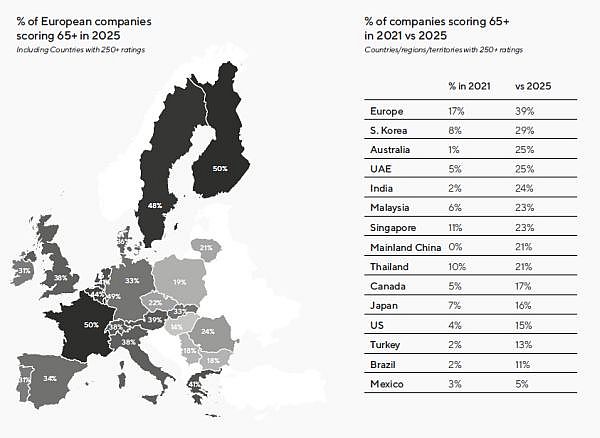
Percentage of rated companies scoring 65+ by country in 2025. (Source: EcoVadis)
Outlook for global exporters
As international reporting regulations expand, consumer goods producers, manufacturers, and packaging companies face mounting pressure from investors and regulators alike. Moving beyond basic policy documentation toward transparent, audit-ready carbon tracking and verifiable risk management is no longer optional—it is rapidly becoming a prerequisite for competing in global trade.
Get the full report: https://ecovadis.com/insights/index-2026/