










JUSTRA: Certainty in resource circularity for mixed materials and waste

In the fields of recycled resources and municipal solid waste, dealing with highly mixed feedstocks, tight spaces, expensive labor, inadequate sorting, and low market values are not abstract challenges—they happen on the production line every single day. To capture stable profits from mixed waste, the industry urgently needs certainty.
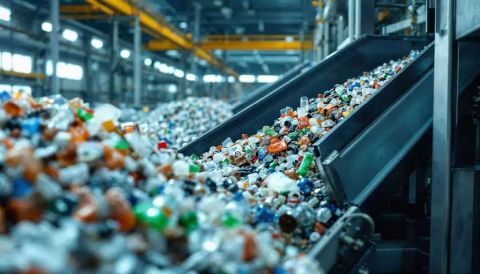
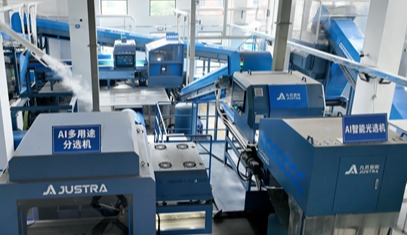
Guangzhou Justra Technology Co., Ltd. (JUSTRA) has focused on next-generation intelligent sorting technology that integrates artificial intelligence (AI) with multi-modal sensors. With 95% of its core hardware and software developed in-house, the company can accurately identify over 260 types of materials. It has built a solid foundation of technology and projects, boasting hundreds of deployed cases, over 100 patents and software copyrights, and more than 60 R&D professionals.
JUSTRA uses real-world data to turn the industry's pain points into stable operational profits. From large sorting centers and municipal solid waste treatment plants to small waste plastic baling stations, multiple deployed production lines have achieved remarkable improvements: labor costs reduced by up to 75%, waste material resale values increased by 35%, municipal solid waste resource recovery rates exceeding 40%, and processing efficiency at small-to-medium-sized sites boosted by 50%.
A 50-Ton/Day Multi-Category Recyclables Sorting Line
Anhui Hefei Multi-Category Recyclables Sorting Center: Covering an area of 5,000 square meters with a designed capacity of 50 tons per day, its primary outputs include three-color PET, premium white plastics, standard white plastics, mixed-color rigid plastics, various grades of waste paper, glass, metal, and foam.
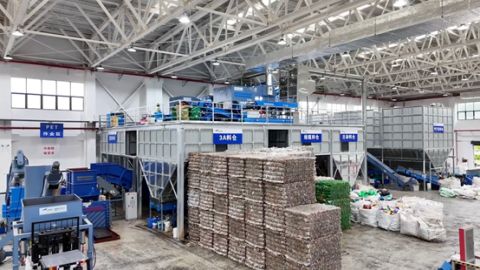
Project Challenges: Traditional equipment struggles to consistently handle incoming feedstocks where round and flat PET bottles, household rigid plastics, and other miscellaneous materials are heavily mixed together. Furthermore, the project aims far beyond simply isolating PET; it requires downstream sorting into three distinct PET colors, as well as high-value categories like 3A-grade and premium white materials. Running a line like this using traditional methods typically requires a continuous crew of over 20 workers.
Project Outcomes: Following implementation, sorting efficiency spiked 10-fold, the resale value of products increased by 35%, sorting labor was slashed by 75%, and line energy consumption dropped by 30%. For multi-category sorting centers of this nature, the true value lies not just in "separating" materials, but in "sorting them with precision, stability, and higher market yields".
A 100-Ton/Day Mixed Municipal Solid Waste Line
While the Hefei project focused on upcycling mixed waste plastics through precision sorting, the Guangzhou Intelligent Mixed Municipal Solid Waste (MSW) Sorting and Recycling Center faced a different challenge: how to effectively extract recyclables—which previously would have been incinerated—directly from mixed municipal solid waste, thereby achieving source reduction and resource recovery.
Guangzhou Intelligent MSW Sorting and Recycling Center: Occupying a footprint of just 1,500 square meters, the site boasts a designed capacity of 100 tons per day. Its primary sorted outputs include PET plastics, household rigid plastics, disposable food containers, scrap metal, Tetra Pak packaging, miscellaneous paper, plastic films, and raw materials for Refuse-Derived Fuel (RDF).
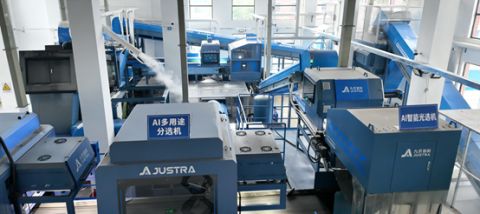
Project Challenges: Due to incomplete source-separation, mixed municipal solid waste often contains a high volume of recyclables. However, because the composition is extremely complex and manual sorting is both costly and difficult, these recyclables historically went unrecovered and ended up in incinerators or landfills. This not only wasted valuable resources but also drove up downstream collection, transport, and disposal costs. Furthermore, since waste transfer stations have highly restricted space, traditional large-scale sorting lines simply cannot fit, let alone achieve high-precision sorting.
Project Outcomes: The sorting line itself occupies a mere 500 square meters, yet it delivers a waste reduction and resource recovery rate exceeding 40% with a 100% unmanned sorting process, saving nearly RMB 2 million annually in waste disposal fees. Crucially, it marks the first time that plastic films—which make up a massive percentage of municipal waste—are sorted by specific material type. This provides reliable feedstock for downstream mechanical recycling or chemical recycling (plastic-to-oil).
Compared to the traditional approach of turning films into low-value RDF fuel, this process exponentially increases the recovery value of plastic films. Even within a highly confined footprint, the center has successfully delivered on waste reduction, resource recovery, and operational profitability.
For municipal solid waste projects, these results are far more convincing than any slogan—because the financial returns speak for themselves.
Turning the Toughest Projects into Proven Results
Nearly all of the projects JUSTRA tackles are among the most difficult to standardize in the resource circularity industry: multi-category mixed recyclables, MSW, and mixed household rigid plastics. Behind each unique scenario lies a completely different set of sorting complexities, spatial constraints, and operational pressures.
Yet, it is precisely because these projects are so complex that the final outcomes are so compelling. Metrics like efficiency, material value, waste reduction rates, recovery rates, labor costs, and profit margins are no longer just figures on paper—they are proven, realized results delivered on-site.
From Case Studies to the CRRE Expo
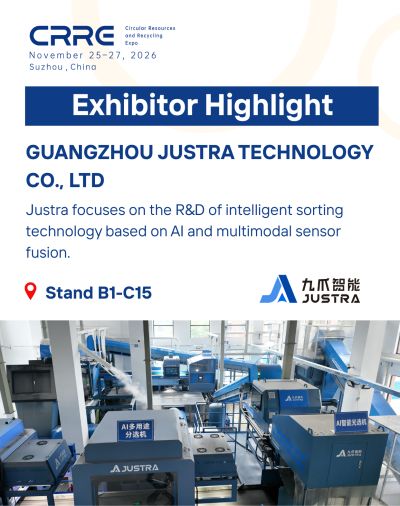
From November 25 to 27, 2026, the Suzhou International Expo Center will host the Circular Resources and Recycling Expo (CRRE), bringing together cutting-edge equipment, technologies, and solutions from the recycling, reprocessing, and high-value application sectors. For industry professionals focused on intelligent sorting, recyclable resource utilization, and MSW recovery, JUSTRA is a highlight exhibitor at CRRE.
About JUSTRA
JUSTRA is a technologically leading provider of premium intelligent sorting equipment and solutions. Its team boasts industry-leading expertise in machine vision and the Internet of Things (IoT), backed by decades of experience in high-end equipment manufacturing and environmental sanitation operations.
The company has already established multiple industry-leading flagship projects in the fields of recyclable resources and municipal solid waste, serving a wide range of top-tier environmental protection enterprises.
About CRRE
CRRE is positioned as a national-level platform, with deep integration across the whole chain and broad international collaboration. It adopts a “summit forum + physical exhibition” dual-engine model. It is committed to building the first five-in-one super hub for resource-circulation in the Asia-Pacific region, covering: recycling – reprocessing – high-value applications – green finance – international rules.
Preregistration:
https://reg.crre-expo.com/CRRE/visitor-registration/eng?Regsource=RAZ23777