




















3D printing a heart: Stanford’s project to bioprint fully functioning human heart

Bioprinting, the 3D printing of living tissue, takes a giant leap forward when a multidisciplinary team from Stanford University received a federal contract to fabricate whole organs from scratch and implanting them in living beings.
Under a new US$26.3 million federal contract from the Advanced Research Projects Agency for Health (ARPA-H), the team aims to bioprint a fully functioning human heart and implant it in a living pig within five years.
What is bioprinting?
The project is pushed forward by the present advancement in stem cell science, the scale of cell production and 3D bioprinting.
Bioprinting is a 3D printing technology that, instead of using plastic or metal, prints living tissues using cell. The key development is that the team can now print cells and blood vessels into those tissues.
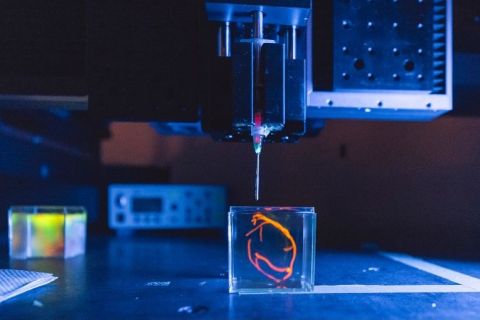
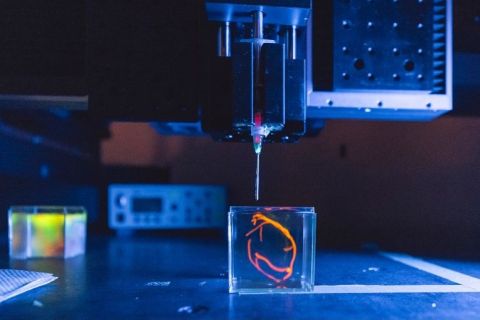
A 3D bioprinter prints a sample of heart tissue.
“With vasculature comes the ability to make large and thick tissues that can be implanted and survive,” said Skylar-Scott, assistant professor of bioengineering in the Schools of Engineering and Medicine and principal investigator on the project. “Thus begins the era of organ biofabrication.”
Closer look to the manmade heart
Skylar-Scott explained that the team would use an automated bank of bioreactors to produce different cell types of the heart.
This bank of bioreactors will turn out billions of ventricular and atrial cardiomyocytes, specialized conduction cells that form the Purkinje fibers, nodal cells that are the heart’s pace-making cells and smooth muscle cells, macrophages that support tissue development, and blood vessel endothelial cells to keep the tissue alive.
The principal investigator estimates that the team will be able to generate sufficient cells for a heart every two weeks.
Your own heart made out of your own cells
The team will practice and learn all the design rules of the heart and optimize viability and function at the whole-heart scale for the eventual implantation into a pig.
The bioprinted human heart will be transplanted into a pig with severe congenital immunodeficiency to prevent rejection.
In real person implantation, however, the team’s approach uses patient-specific stem cells, which may not require immunosuppression when transplanted into the same patient.