





















World’s largest polymer 3D printer for producing wind turbine tooling

TPI Composites announced a groundbreaking initiative in partnership with the University of Maine Advanced Structures and Composites Center (ASCC) and Oak Ridge National Laboratory to produce wind turbine tooling with one of the world's largest 3D printers.
The goal of this project is to understand how new technologies can provide faster, lower-cost precision manufacturing of large modular wind blade tooling. Demonstration of this technology will enable lower cost transportation and rapid assembly of multi-megawatt scale wind blade molding systems anywhere on the globe.
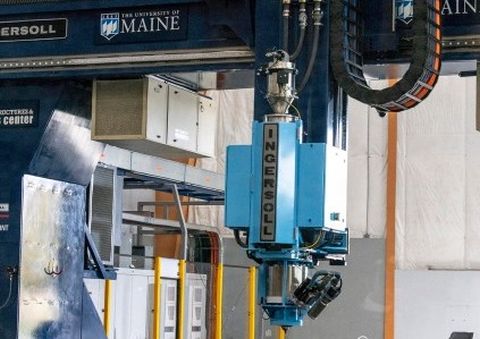
ASCC’s Ingersoll MasterPrint, the world’s largest polymer 3D printer, can print modular wind blade tooling at 500lb/hour, with segments up to 18.3m long x 6.7m wide x 3.0m high.
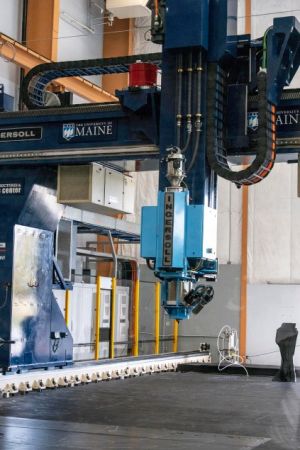
Ingersoll MasterPrint, the world’s largest polymer 3D printer from University of Maine Advanced Structures and Composites Center. (Source: University of Marine)
With a 5-axis machining head, the printer can achieve 5 mil precision, allowing tooling segments to be joined, to maintain vacuum integrity, and to provide the dimensional accuracy demanded in wind blade manufacturing.
Also as part of the project, the tooling will incorporate 3D-printed heating elements using coextruded resistive wire to achieve uniform mold temperatures within 5°C and heating rates of 0.5°C per minute.
The wind turbine tooling will be 100% recyclable and may reduce large blade product development cycles and tooling costs by as much as 50%.
“By leveraging 3D printing technology, we are looking at ways to streamline our tooling process and pave the way for more efficient and cost-effective wind blade production,” said Bill Siwek, President and CEO of TPI Composites.