









New material that could replace glass for green building

Researchers at the Karlsruhe Institute of Technology (KIT) introduce a polymer-based material with unique properties for energy-efficient light and temperature regulation in buildings.
This material allows sunlight to enter, maintains a more comfortable indoor climate without additional energy, and cleans itself like a lotus leaf. The new development could replace glass components in walls and roofs in the future.
Maximizing natural light in buildings can save on energy costs. However, traditional glass roofs and walls also present problems such as glare, lack of privacy, and overheating.
Innovative material combines multiple functions
This polymer-based Micro-Photonic Multi-Functional Metamaterial (PMMM) consists of microscopic pyramids made of silicone. These micro-pyramids measure about ten micrometers, which is about one-tenth the diameter of a hair.
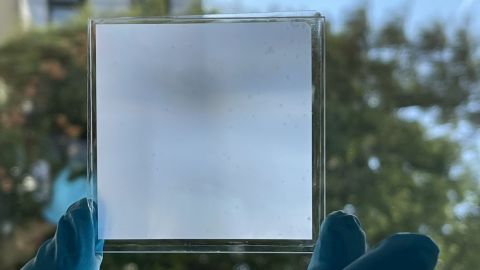
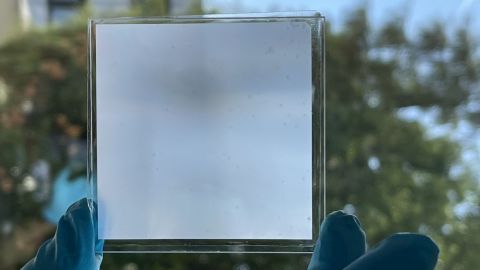
PMMM film combines several functions: light diffusion, self-cleaning, and radiative cooling while maintaining high transparency. (Photo: Gan Huang, KIT)
This design gives the PMMM film several functions: light diffusion, self-cleaning, and radiative cooling while maintaining a high level of transparency.
A key feature is the ability to efficiently radiate heat through the Earth's atmosphere's long-wave infrared transmission window, releasing heat into the cold expanse of the universe. This allows for passive radiative cooling without electricity consumption.
More transparent and glare-free
In the lab and in experiments under open skies under real outdoor conditions, the researchers tested the material's properties and performance using modern spectrophotometry.
The tests achieved cooling of 6°C compared to the ambient temperature. Additionally, the material showed a high spectral transmittance, or transparency, of 95%. In comparison, glass typically has a transparency of 91%. At the same time, the micro-pyramid structure scatters 73% of the incoming sunlight, resulting in a blurry appearance.
When the material is used in roofs and walls, it allows for bright yet glare-free and privacy-protected indoor spaces for work and living. In greenhouses, the high light transmittance could increase yields because the photosynthesis efficiency is estimated to be 9% higher than in greenhouses with glass roofs.
The micro-pyramids also give the PMMM film superhydrophobic properties, similar to a lotus leaf: water beads up in droplets and removes dirt and dust from the surface. This self-cleaning function makes the material easy to maintain and durable.