















Search History
Clear History
{{item.search_key}}
Hot Searches
Change
{{item.name}}
{{item.english_name}}
Subscribe eNews
Once A Week Once Every Two Weeks
{{sum}}
Login Register

Applications

CEFLEX: Broader markets crucial for PCR derived from flexible packaging

Borouge International launches Borcycle rPP for demanding structural auto parts

Amcor research: European consumers embrace refills in beauty and personal care

Products

India extends anti-dumping duty on Chinese PET resin

Clariant expands flame retardant portfolio for e-mobility

ARLANXEO and Covestro advance sustainable production for synthetic rubber

Activities

  • PLAST 2026 concluded beyond expectations

  • CRRE inks agreement with 5 key players in wind and solar equipment circularity

  • Fakuma 2026: Multi-faceted program for plastics industry

Pictorial

News Videos

A talk with Italian injection molding expert BMB

Inside Moretto: A tour of their Italian production facilities

Top 10 Technology Trends awards presented at CHINAPLAS 2026

Conference Videos

Summit Dialogue: Policy alignment and practices in plastic recycling across Asia

Interview: Pathways for development of plastics recycling in Malaysia

Driving systemic change: Unilever’s evolution in the circular economy

Corporate/Product Videos

For Rubber & Plastic Extrusion Equipment, trust Hebei Zhongsen! Custom Extruders, Traction Machines & Vulcanizing Lines

Is Your Mold Supplier Really Giving You Peace of Mind?

Kurtz GmbH & Co.

Home > News > Packaging

CEFLEX: Broader markets crucial for PCR derived from flexible packaging

Source:Adsale Plastics Network Date :2026-06-26 Editor :RC
Copyright: This article was originally written/edited by Adsale Plastics Network (AdsaleCPRJ.com), republishing and excerpting are not allowed without permission. For any copyright infringement, we will pursue legal liability in accordance with the law.

Recent disruptions in global polymer markets, combined with a sharp rise in virgin plastic prices, have strengthened the price competitiveness of recycled material and driven increased demand.


However, while these dynamics may deliver short-term economic benefits, the volatility of recent years has shown that demand can shift rapidly. This underscores the need for sustained focus on the underlying structural barriers to demand — ensuring that sufficient markets for recycled plastic are maintained across all market conditions.


CEFLEX, an initiative representing entire value chain of flexible packaging in Europe, released a report “Secondary Applications for Recycled Content – Key Insights for Flexible Packaging”, examining how recycled material derived from polyolefin-based flexible packaging is likely to be used in practice as EU legislative targets for recycled content and recycling rates come into force.


Additional PCR-based flexible packaging required to achieve PPWR targets


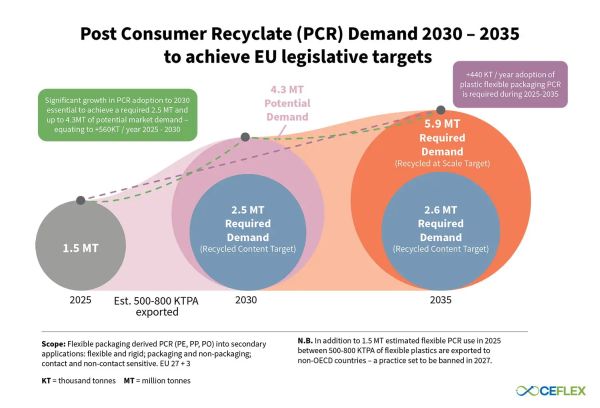
The report finds that around 2.5 million tons of flexible packaging derived post-consumer recycled (PCR) material will be required by 2030 to meet PPWR recycled content targets in flexible packaging, encompassing recycled polyethylene, polypropylene and mixed polyolefins.


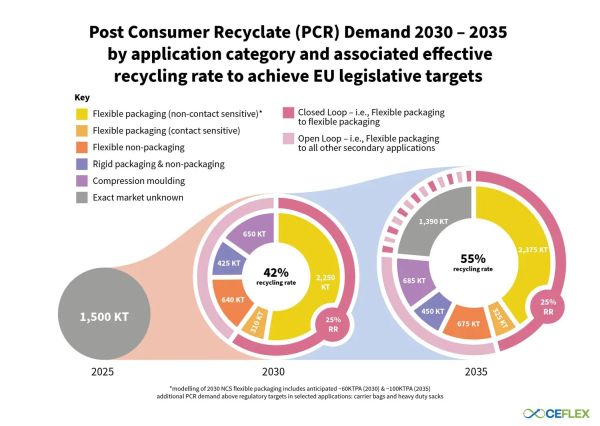
The report also identifies that the 55% recycling rate targets for all plastic packaging formats in 2035 will have an additional significant effect on PCR markets and use.


This target drives more material through the system, effectively meaning that markets and secondary applications will need to be found for an estimated 5.9 million tons of flexible packaging derived PCR in 2035.


Taken together, this means adoption of an additional 440,000 tons a year of flexible packaging derived PCR is required every year between 2025-2035 to achieve PPWR targets.
 

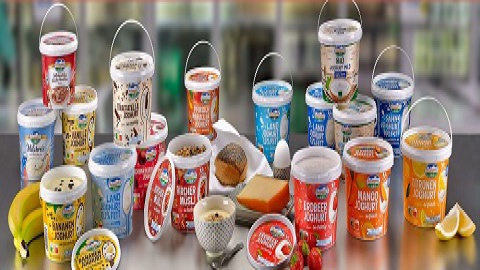
CEFLEX_PCR flexible packaging report_01.jpg


CEFLEX highlights that material quality, and the collection, sorting and recycling infrastructure needed to ensure recycled materials can be used again will be critical in enabling this shift.


Pushing recycling rates: Non-regulated markets and open-loop applications


As PPWR will be fully implemented in August 2026, the recycled content targets from the regulation will create strong demand for recycled content in packaging. However, the wider circular economy for flexible packaging and recycling rate targets also depend on markets that are not directly driven by PPWR.


CEFLEX analysis identifies a broader set of established secondary markets that already use, and could absorb more PCR-based flexible packaging. When these markets are included, total potential PCR demand rises to around 4.3 million tons in 2030.


These markets include construction films, refuse sacks, transport packaging, horticulture products and other rigid applications. They are important because packaging alone is unlikely to absorb all the recycled material needed to support higher recycling rates.
 

CEFLEX_PCR flexible packaging report_02.jpg


Open-loop applications provide further outlets for material that can replace virgin resources, but they are often more exposed to normal market conditions. If PCR is not available at the right quality, price and consistency of supply, users will revert to virgin material.


Meeting the minimum PCR demand in packaging is a priority, but it is not enough on its own. A functioning circular materials system also needs wider secondary applications to develop in parallel, so that higher recycling rates translate into more recycled material replacing virgin resources.


 Like 丨  {{details_info.likes_count}}
Flexible packaging
Recycled plastics
Europe
Circular economy
PCR
 ZHANGJIAGANG XINRONG MACHINERY CO.,LTD      
 NANJING SAGE ADVANCED MATERIALS CO.,LTD      
 GOOD VISION & MOTION(SHENZHEN)CO,. LTD.      
 HEFEI TAIHE INTELLIGENT TECHNOLOGY GROUP CO.,LTD.      
 GUANGDONG GUOHENG YOUHE ADVANCED MATERIALS CO., LTD.      
 KADIDE      
 HUIZHOU LITUO ADVANCED MATERIALS CO.,LTD.      
 XIAMEN XINWANCAI POLYMER TECHNOLOGY CO.,LTD      
 ANHUI ZHONGXIN HONGWEI TECHNOLOGY CO.,LTD      
 GUANGZHOU PULISI TECHNOLOGY CO.,LTD.      

The content you're trying to view is for members only. If you are currently a member, Please login to access this content.   Login

Source:Adsale Plastics Network Date :2026-06-26 Editor :RC
Copyright: This article was originally written/edited by Adsale Plastics Network (AdsaleCPRJ.com), republishing and excerpting are not allowed without permission. For any copyright infringement, we will pursue legal liability in accordance with the law.

Recent disruptions in global polymer markets, combined with a sharp rise in virgin plastic prices, have strengthened the price competitiveness of recycled material and driven increased demand.


However, while these dynamics may deliver short-term economic benefits, the volatility of recent years has shown that demand can shift rapidly. This underscores the need for sustained focus on the underlying structural barriers to demand — ensuring that sufficient markets for recycled plastic are maintained across all market conditions.


CEFLEX, an initiative representing entire value chain of flexible packaging in Europe, released a report “Secondary Applications for Recycled Content – Key Insights for Flexible Packaging”, examining how recycled material derived from polyolefin-based flexible packaging is likely to be used in practice as EU legislative targets for recycled content and recycling rates come into force.


Additional PCR-based flexible packaging required to achieve PPWR targets


The report finds that around 2.5 million tons of flexible packaging derived post-consumer recycled (PCR) material will be required by 2030 to meet PPWR recycled content targets in flexible packaging, encompassing recycled polyethylene, polypropylene and mixed polyolefins.


The report also identifies that the 55% recycling rate targets for all plastic packaging formats in 2035 will have an additional significant effect on PCR markets and use.


This target drives more material through the system, effectively meaning that markets and secondary applications will need to be found for an estimated 5.9 million tons of flexible packaging derived PCR in 2035.


Taken together, this means adoption of an additional 440,000 tons a year of flexible packaging derived PCR is required every year between 2025-2035 to achieve PPWR targets.


CEFLEX_PCR flexible packaging report_01.jpg


CEFLEX highlights that material quality, and the collection, sorting and recycling infrastructure needed to ensure recycled materials can be used again will be critical in enabling this shift.


Pushing recycling rates: Non-regulated markets and open-loop applications


As PPWR will be fully implemented in August 2026, the recycled content targets from the regulation will create strong demand for recycled content in packaging. However, the wider circular economy for flexible packaging and recycling rate targets also depend on markets that are not directly driven by PPWR.


CEFLEX analysis identifies a broader set of established secondary markets that already use, and could absorb more PCR-based flexible packaging. When these markets are included, total potential PCR demand rises to around 4.3 million tons in 2030.


These markets include construction films, refuse sacks, transport packaging, horticulture products and other rigid applications. They are important because packaging alone is unlikely to absorb all the recycled material needed to support higher recycling rates.


CEFLEX_PCR flexible packaging report_02.jpg


Open-loop applications provide further outlets for material that can replace virgin resources, but they are often more exposed to normal market conditions. If PCR is not available at the right quality, price and consistency of supply, users will revert to virgin material.


Meeting the minimum PCR demand in packaging is a priority, but it is not enough on its own. A functioning circular materials system also needs wider secondary applications to develop in parallel, so that higher recycling rates translate into more recycled material replacing virgin resources.


全文内容需要订阅后才能阅读哦~
立即订阅

Recommended Articles

Packaging
CEFLEX: Broader markets crucial for PCR derived from flexible packaging
 2026-06-26
Packaging
Amcor research: European consumers embrace refills in beauty and personal care
 2026-06-25
Packaging
hubergroup expands UV offset portfolio with low tack ink grade
 2026-06-23
Packaging
PureCycle and Innovia Films partner to produce white, cavitated BOPP film with rPP
 2026-06-22
Packaging
Amcor accelerates healthcare packaging expansion in India
 2026-06-17
Packaging
Mondi introduces packaging with 35% PCR content for wet wipes
 2026-06-04

You May Be Interested In

Change

  • People
  • Company
loading... No Content

{{[item.truename,item.truename_english][lang]}} {{[item.company_name,item.company_name_english][lang]}} {{[item.job_name,item.name_english][lang]}}
{{[item.company_name,item.company_name_english][lang]}} Company Name    {{[item.display_name,item.display_name_english][lang]}}  

Polyurethane Investment Medical Carbon neutral Reduce cost and increase efficiency CHINAPLAS Financial reports rPET INEOS Styrolution Evonik Borouge Polystyrene (PS) mono-material Sustainability Circular economy BASF SABIC Multi-component injection molding machine All-electric injection molding machine Thermoforming machine

CEFLEX: Broader markets crucial for PCR derived from flexible packaging

识别右侧二维码,进入阅读全文
下载
x 关闭
订阅
亲爱的用户,请填写一下信息
I have read and agree to the 《Terms of Use》 and 《Privacy Policy》
立即订阅
Top
Feedback
Chat
News
Market News
Applications
Products
Video
In Pictures
Specials
Activities
eBook
Front Line
Plastics Applications
Chemicals and Raw Material
Processing Technologies
Products
Injection
Extrusion
Auxiliary
Blow Molding
Mold
Hot Runner
Screw
Applications
Packaging
Automotive
Medical
Recycling
E&E
LED
Construction
Others
Events
Conference
Webinar
CHINAPLAS
CPS+ eMarketplace
Official Publications
CPS eNews
Media Kit
Social Media
Facebook
Linkedin