












Zhongan Eco: Waste pretreatment lines for retired wind blades and PV modules

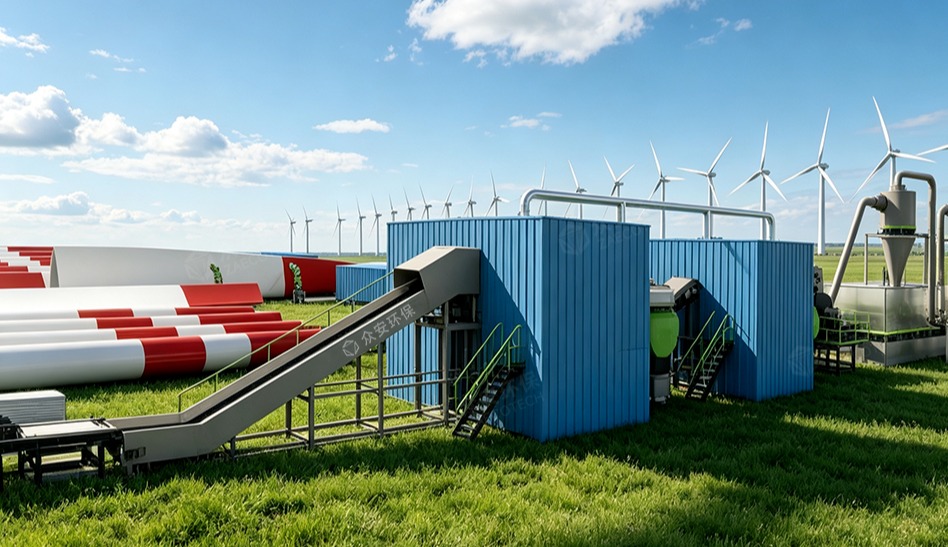
A wind blade runs close to 100 meters and bonds glass fiber, resin, and core material into one composite. Even after on-site cutting, the sections reaching a recycling plant are large, tough, and awkward to feed continuously.
A photovoltaic module poses the inverse problem: aluminium frame, junction box, glass, silicon, and copper are stacked in layers thin enough that separation depends on each crushing and screening stage handing the right fraction to the next.
Industrial and biomass waste add a third difficulty — composition and particle size vary so widely that front-end equipment must absorb the variation without stopping.
Zhengzhou Zhongan Eco Co., Ltd. (众安环保) works on these streams, developing over 30 types of solid-waste pretreatment equipment — shredding, crushing, milling, sorting, conveying, dust extraction — for municipal, industrial, new-energy, and biomass waste, and supplies roughly 1,000 system solutions per year.
Wind blades
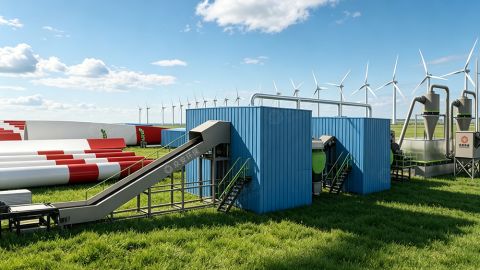
Blades are cut on site, fed by metal chain-plate conveyor into a coarse crusher, then pass through magnetic separation, fine crushing, sorting, and milling into fiber, small pieces, and powder. A high-torque crusher handles blade sections up to 120 mm thick; the company states the system uses about 30% less power than conventional lines, with 99.9% dust removal. Negative-pressure dust suppression, fire protection, noise control, and remote monitoring are built in for continuous operation.
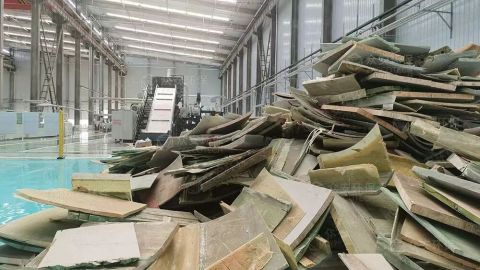
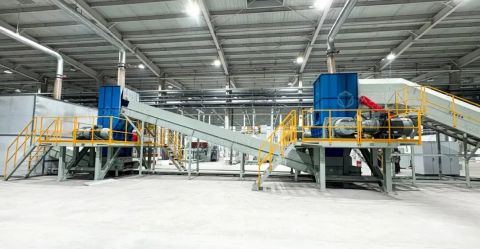
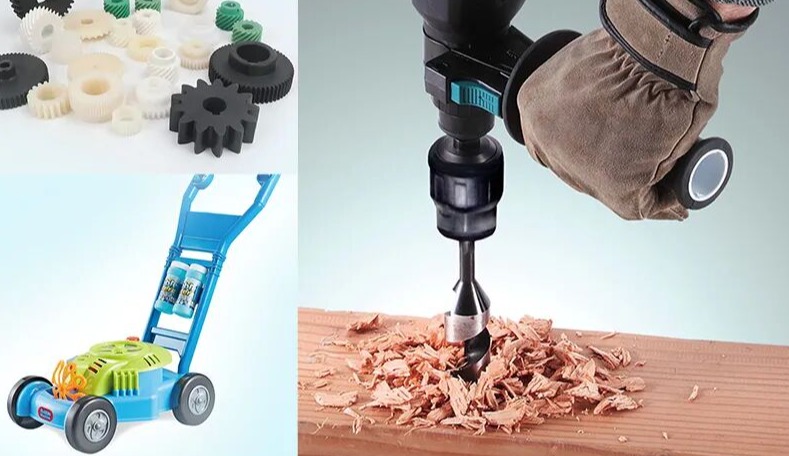
Projects in Hebei and Xinjiang run at 10,000-ton scale, combining automatic feeding, staged crushing, classified sorting, and fine milling. Recovered glass fiber and resin powder go into heavy-duty industrial pallets, outdoor building materials, permeable roadbase, and logistics packaging.
Photovoltaic modules
Frames and junction boxes are removed automatically, then multi-stage crushing, screening, sorting, and milling separate glass, silicon, copper, and aluminium using four-shaft crushers, glass screens, copper-aluminium separators, air classifiers, and fine screens.
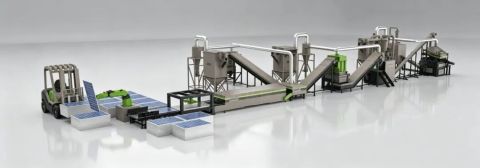
The process is physical — no chemical reagents, no wastewater, no waste gas. Throughput reaches 40–60 modules per hour, above 10,000 tons a year, with the company reporting 96% overall recovery.
RDF for cement kilns
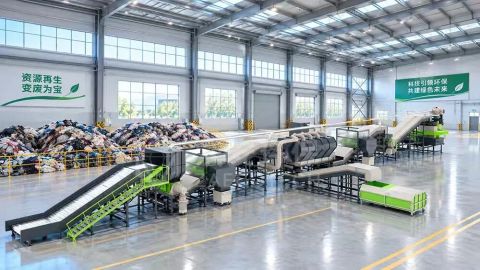
Mixed industrial waste — textile, plastic, leather, rubber strip — becomes RDF/SRF alternative fuel. A 2026 project at a leading Southeast Asian cement producer runs chain-plate feeding, twin-shaft shear shredding, and magnetic iron removal under automatic control, holding 20–25 t/h with finished RDF at 100–120 mm and calorific value within the kiln's co-firing requirement. The line completes waste to fuel to cement.
Biomass
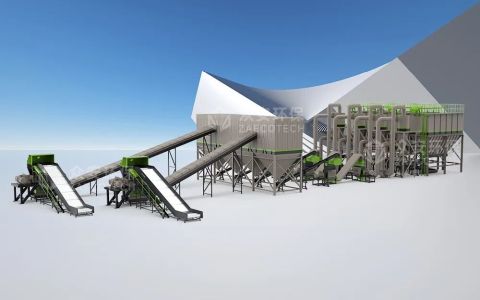
For a biomass ethanol project in northeast China, Zhongan Eco supplied the core pretreatment equipment: dry feeding, metered dosing, ultra-fine straw milling, twin-drum processing, tubular mixing, compression screw, tubular reactor, pulse discharge, and pulsed steam explosion — providing continuous, stable feedstock for industrial-scale ethanol production.
About the CRRE exhibitor
Zhengzhou Zhongan Eco Co., Ltd. drawing on more than 20 years of equipment manufacturing experience at its production plant. It develops over 30 types of solid-waste pretreatment equipment — shredding, crushing, milling, sorting, conveying, dust extraction.
Booth: C1E31
About CRRE
CRRE is positioned as a national-level platform, with deep integration across the whole chain and broad international collaboration. It adopts a “summit forum + physical exhibition” dual-engine model. It is committed to building the first five-in-one super hub for resource-circulation in the Asia-Pacific region, covering: recycling – reprocessing – high-value applications – green finance – international rules.
Preregistration:
https://reg.crre-expo.com/CRRE/visitor-registration/eng?Regsource=RAZ23777