













Jiaren New Materials: Recycled DMT from waste polyester at 99.9% purity

Mechanical recycling cuts polymer chains and carries contamination through, so a dyed garment or a mixed-color bottle is downcycled rather than returned to its original use.
Chemical recycling takes the other route — depolymerizing polyester back to a monomer that re-enters polymerization. The difficulty is purity. Dyed, blended, and contaminated feedstock must first be broken down, then purified to a specification that polyester producers will accept.
Zhejiang Jianxin Jiaren New Materials Co., Ltd. (佳人新材料) was founded in 2012 and works solely on chemically recycled polyester. Its Paojiang base in Shaoxing processes about 40,000 tons of waste textiles a year into roughly 30,000 tons of recycled product. In 2026 the group's new Keqiao base began operating, with a first 50,000-tonne phase in production and commercial-scale recycled DMT output reached at the ten-thousand-ton level.
Recycled DMT
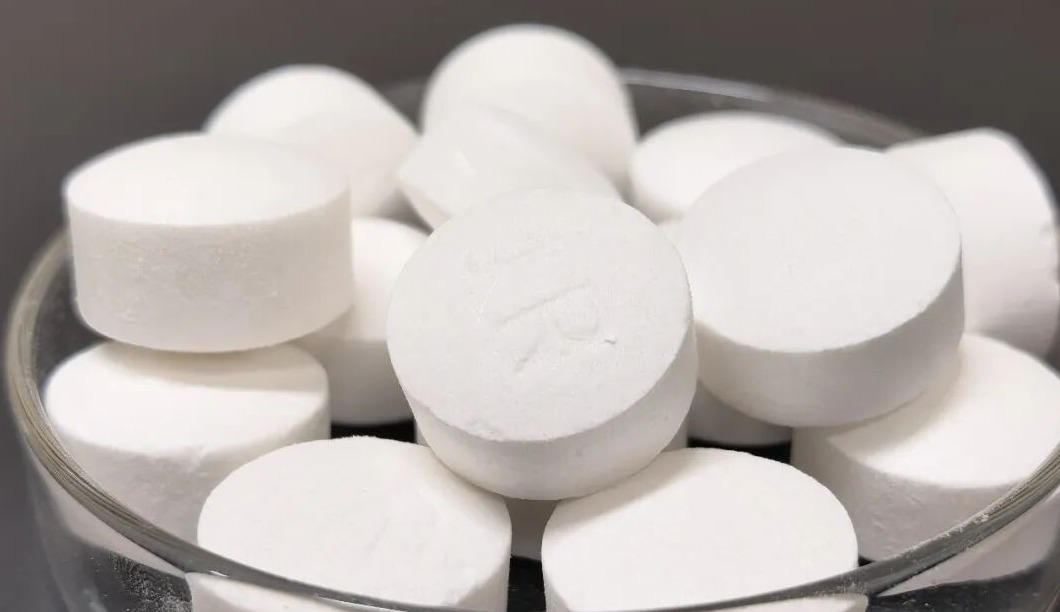
Jiaren depolymerizes waste polyester, then filters, separates, distils, and purifies the product into DMT — dimethyl terephthalate, the monomer from which polyester is built. The company's RDMT reaches 99.9% purity. Waste textile processing runs through more than ten stages, including depolymerization, filtration and separation, decolorization, and purification.
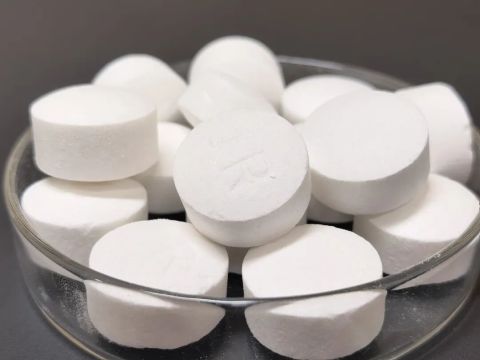
Because the polymer is reduced to a monomer and returned to polymerization, the output can serve the same product families as virgin DMT — the distinction from mechanical recycling, which produces a lower-grade material rather than a chemical equivalent. Grades include fiber-grade and industrial-grade RDMT, the latter reaching cosmetic packaging and plastic products.
Bottle to bottle
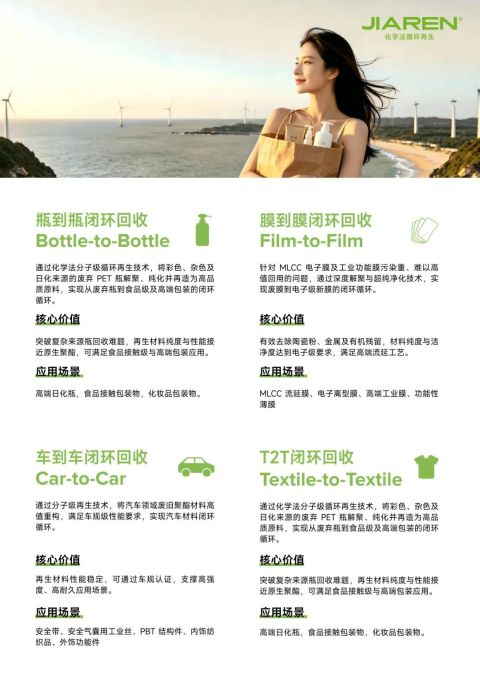
The bottle-to-bottle line takes colored, mixed-color, and household-chemical PET bottles. Beyond shape and color, chemical recycling has to remove the full impurity load and then purify to specification. The closed loop covers household chemical bottles, food-contact packaging, and cosmetic packaging.
Film to film
MLCC dielectric film, release film, and other functional film production generates scrap carrying ceramic powder, metal, and organic residue — difficult to mechanically recycle without quality loss. Jiaren's film-to-film project depolymerizes and ultra-purifies this scrap back into electronic-grade material for precision film casting.
Downstream
Recycled DMT re-enters polyester production as chip and fiber for sportswear, automotive interiors, packaging, and industrial film. The Keqiao base uses self-developed process and equipment technology, with a pilot workshop, an SSP workshop, and full DCS automation.
About the CRRE exhibitor
Founded in 2012, Zhejiang Jiaren New Materials Co., Ltd. develops chemical recycling of polyester with its technology team and domestic research institutes, building a system that covers recycled DMT, recycled chip, and recycled fiber.
Booth: B1D35
About CRRE
CRRE is positioned as a national-level platform, with deep integration across the whole chain and broad international collaboration. It adopts a “summit forum + physical exhibition” dual-engine model. It is committed to building the first five-in-one super hub for resource-circulation in the Asia-Pacific region, covering: recycling – reprocessing – high-value applications – green finance – international rules.
Preregistration:
https://reg.crre-expo.com/CRRE/visitor-registration/eng?Regsource=RAZ23777