






















World’s tallest 3D-printed building lightens Swiss village

Mulegns, a mountain village in Switzerland threatened by depopulation that is currently home to 11 people, welcomes Tor Alva (meaning “White Tower” in Romansh), the world’s tallest 3D-printed tower.
This building is an initiative of the Origen cultural foundation (Nova Fundaziun Origen) in collaboration with ETH Zurich, and is designed to serve as a cultural hub and to revive the village.
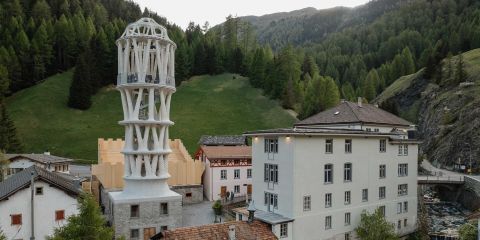
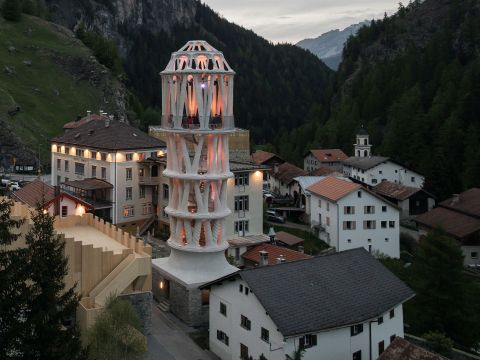
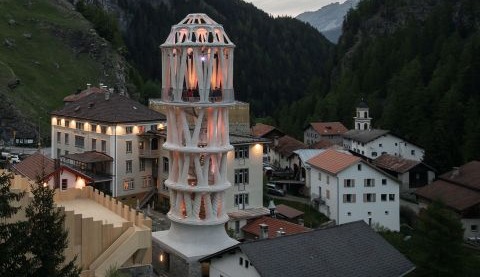
Tor Alva, the world’s tallest 3D-printed building, in Mulegns, Switzerland.
Cultural design and digital craftsmanship
Tor Alva was designed by architect Michael Hansmeyer and ETH Professor of Digital Building Technologies Benjamin Dillenburger.
The tower’s form of structure is reminiscent of an ornate layered cake – a reference to the emigration history of confectioners from Graubünden who exported their skills from here to the whole of Europe.
Thirty-two sculptured white concrete columns rise up over four stories, becoming thinner and more branched, before fanning out in an almost tree-like fashion to form the domed space at the top.
The White Tower showcases how digital construction techniques can be used to build load-bearing structures without formwork.
Instead of relying on traditional concrete formwork, they opted for an additive manufacturing process, whereby an industrial robot applies the concrete layer by layer into free-form elements without any supportive casting molds. The design is based on complex algorithms that generate the ornamental and the structural aspects at the same time.
Specially developed concrete as building material
To make this process possible, a specially developed concrete was needed. It had to be soft enough to bond the delicate structures, while hardening quickly enough to support the subsequent layers.
Robert Flatt, ETH Professor of Physical Chemistry of Building Materials, developed a novel mixture for this purpose. Just before the concrete leaves the pressurized nozzle, two additives are blended into the mixture, allowing the characteristic droplet-like relief on the columns to be achieved.
Safe construction with 3D-printed concrete
The highlight of this project is that the 3D-printed elements not only serve as a shell, but for the first time they are also load-bearing.
Until now, a suitable method to reinforce 3D-printed concrete effectively has been lacking. This is now possible thanks to a newly developed reinforcement concept implemented using a robot-assisted innovation.
While one robot applies the concrete in layers, a second places a ring-shaped reinforcement in the new structure every 20 cm. This horizontal reinforcement in the form of rings is supplemented by longitudinal rebars that are added after printing.
The process, known as “reinforcement that grows” was developed by ETH professors Walter Kaufmann, Robert Flatt and Benjamin Dillenburger, in conjunction with the ETH spin-off Mesh and the company Zindel United.
In addition, the researchers developed a new testing method which allows the load-bearing capacity of 3D-printed concrete to be reliably calculated for the first time. This is a key requirement to ensure that such buildings can in future be tested just as safely as conventional reinforced concrete structures.
It took five months to print the columns on the ETH Hönggerberg campus. The components were then assembled in Savognin and delivered to Mulegns via the Julier road in a heavy goods vehicle.
Inauguration and future use
Tor Alva was officially inaugurated on May 20. The cover was only removed by helicopter on the eve of the opening, revealing the delicate, white structure, which now blends into the mountain landscape of the Julier Pass.
The opening ceremony was filled with project partners, public officials and distinguished guests from science, politics and arts areas to recognize the tower’s symbolic and technical significance.
Starting from May 23, the White Tower will be open daily for guided tours. From July onwards, the space will also host staged performances. Tor Alva is intended to remain in Mulegns for around five years. It can later be dismantled and re-erected elsewhere.