









Local to local: Arburg unveils Allrounder Trend in China

"The worldwide market situation—whether global, continental or local—remains hard to predict, and both we and our customers will have to keep adapting."
Arburg, a global leading manufacturer of injection molding machine, unveils the electric Allrounder Trend in China. With short delivery lead times, quick setup, intuitive operation, and easy maintenance, the series is especially well suited to Asian injection molding companies, particularly those in the mobility and electronics industries.
Another new product is the Gestica lite control system with a modern dashboard, which also contributes to simple operation and a clear user interface. In addition, four clamping forces are available, ranging from 500 to 2,000 kN, and with electric injection units in sizes 100 to 800. The injection speed is 200, 350 and 500 millimeters per second.
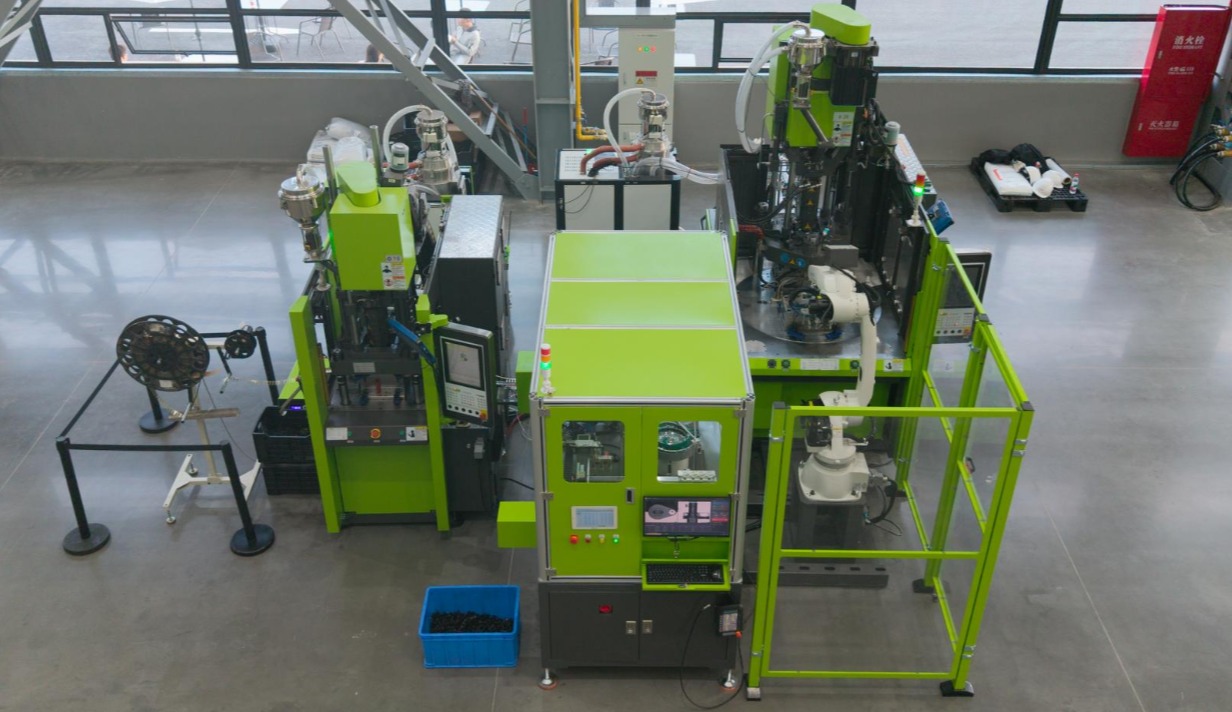
At CHINAPLAS 2026, visitors can see two of these new standard machines: an Allrounder 1000 e Trend with a clamping force of 1,000 kN that produces PCB connectors from LCP; and another equipped with a Flexlift 10+2 robotic system, which produces gears from POM.
Also showcased is the Flexlift robotic system, specifically designed for Asia. The linear robot system can be equipped with application-specific drives, valve sets and variable control cabinet positioning.
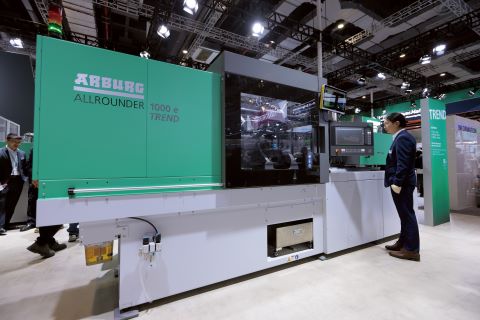
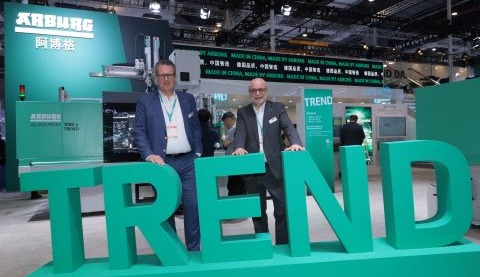
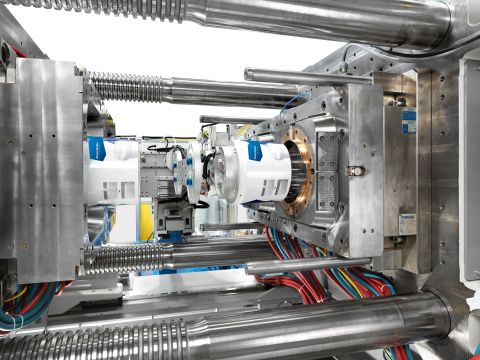
Arburg's new Allrounder Trend electric injection molding machine at CHINAPLAS 2026.
"Local to local" production serves the Chinese and Asian markets
As part of Arburg's "local to local" strategy, the new Allrounder Trend machines are assembled at Arburg Technology Factory in Pinghu, China. They follow the electric Allrounder Golden Electric Evo as the second injection-molding machine series to be assembled there.
These machines are supplied to markets across China and Asia as well as customer-specific, tailor-made turnkey production cells.
According to Dr. Volker Nilles, CEO of Arburg, a completely new assembly concept was developed for the assembly of the new Allrounder Trend machines and was implemented in Pinghu, with "local sourcing" playing a key role. Meanwhile, core components such as the plasticizing unit and control system continue to be supplied by the company's German headquarters.
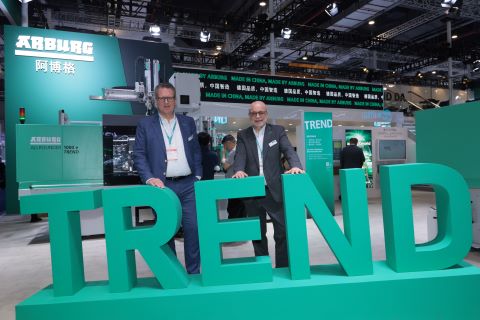
Dr. Volker Nilles, CEO, (Left) and Dr.Christoph Schumacher, Vice President, Global Marketing .
Integrating AI into control systems and customer support
Arburg has long been deeply involved in AI, including AI‑supported assistants and pilots for the Gestica control system. The company's focus areas include boosting performance with its manufacturing execution system ALS; improving efficiency with the energy monitor and the new "aXw Control MoldlifeAssist" feature for machine–mold communication; and enhancing usability with the upgraded "Ask Arburg" customer portal app.
Dr. Nilles explains that MoldlifeAssist supports mold setup, monitoring and maintenance, improving availability through longer mold life and enhanced operator safety. The AI‑supported Ask Arburg feature functions like ChatGPT—but in a secure, self‑contained environment—and answers specific questions about all Arburg products and injection‑molding processes.
Promising growth in Asia amid global uncertainties
The establishment of the Arburg Technology Factory in Pinghu reflects the strong demand for plastic-processing machines and the promising outlook for China and Asia. Dr. Nilles expects continued growth in Asian markets in the coming years, with particularly strong expansion in India, Thailand, Malaysia, Indonesia and Vietnam.
He notes that demand remains highest in the electronics industry, while the mobility sector in Asia is being supported by the development of EV platforms. "Reliable, high‑precision standard machines are used in both sectors," he adds.
Meanwhile, growth is expected from the developing medical sector, and the packaging industry also offers significant potential. Demand spans the full spectrum of equipment for producing medical devices and packaging—from standard machines to high‑end system solutions. "Overall, the trend toward all‑electric injection‑molding machines will continue in Asia," he concludes.
Faced with an uncertain external environment, the plastics and mechanical‑engineering sectors endured a difficult 2025, and challenging conditions look set to continue into 2026.
"We are still operating in a period marked by far‑reaching geopolitical and geo‑economic influences on the economy. Added to this are changing market requirements such as faster time to market and intense price pressure," he says. "The worldwide market situation—whether global, continental or local—remains hard to predict, and both we and our customers will have to keep adapting.
"Despite the difficult environment, we remain positive about the future," he emphasizes. "As a trusted partner in sustainable plastics processing, we have the right solutions for our customers' needs, from standard machines to high‑end, efficient systems."
As Arburg's new CEO since January 2026, what are Dr. Nilles' plans for the company?
"My goal is to put Arburg on a stable, ambitious growth path worldwide and to further develop the company’s enormous potential," he says.
Booth: 4.1D42